
Understanding fear of flying: causes, symptoms and forms of anxiety
Fear is a fundamental human emotion that shows up as an unpleasant feeling of worry, nervousness or dread. Becoming aware of your fears is a crucial first step toward managing them.
Fear of flying (aviophobia) is a common specific phobia — around 16% of people experience it. It ranges from mild nervousness to a panic attack and stems from biological, psychological and learned factors. The good news: it is one of the most treatable anxieties. Helpful first steps are realistic knowledge about flight safety and structured, behavioral-therapy-based training.
1. What is fear of flying?
Fear of flying is one of the most widespread specific phobias and affects people all over the world. This anxiety disorder can appear across a broad spectrum — from mild nervousness before and during the flight to severe panic attacks that can make travel extremely difficult.
Medically known as aviophobia, it describes an intense and often irrational fear of flying. It affects people of every age group and walk of life, and can significantly restrict both professional and personal life.
How does fear of flying show up?
Fear of flying manifests on several levels:
Physical symptoms:
- Racing heart
- Shortness of breath
- Excessive sweating
- Nausea or dizziness
Psychological symptoms:
- A feeling of helplessness and of being at the mercy of the situation
- Anxious thoughts, often accompanied by catastrophic scenarios
- Panic attacks that can occur during the flight
Behavioral patterns:
- Avoidance of flights and related situations
- Excessive preparation or calming rituals before the flight
Did you know?
According to a survey by the Institut für Demoskopie Allensbach, 16% of respondents reported fear of flying, 22% described strong discomfort, and only 52% said they felt no anxiety at all when flying.
It is important to know that fear of flying can be overcome. With professional support, proven techniques and targeted preparation, those affected can successfully manage their fears.

2. When does fear of flying become a phobia?
A queasy feeling at takeoff, sweaty palms during turbulence or a brief moment of tension on approach — a certain amount of unease while flying is common and entirely normal. It does not mean you have a disorder that needs treatment. What matters is whether the fear stays proportionate or starts to dictate your behavior and your life choices.
A specific phobia is present when the fear of flying is persistent, excessive and out of proportion to the actual danger — and when the situation is either endured with intense anxiety or avoided altogether. The ICD-11 (the current classification system of the World Health Organization) and the AWMF S3 guideline classify pronounced fear of flying (aviophobia) as a specific phobia.
Normal unease or anxiety that needs treatment?
Several signs help to tell the two apart:
- The anxiety appears almost every time flying comes up — often days or weeks before the flight.
- It is out of proportion to the real danger and can barely be eased by rational arguments.
- It causes noticeable distress or avoidance: flights get canceled, important trips for work or personal reasons never happen.
- The state persists over a long period and does not improve on its own.
How common are specific phobias?
Specific phobias are among the most common mental disorders of all. The Dresden Mental Health Study puts the lifetime prevalence of specific phobias at around 12.8%. Fear of flying is therefore part of a widespread — and well-studied — phenomenon.
When professional help makes sense
If the anxiety limits your everyday life, if you regularly avoid flights, or if the burden lasts for months, it is wise to seek medical or psychotherapeutic advice. Specific phobias are among the most treatable anxiety disorders — cognitive behavioral therapy with exposure exercises is considered the method of choice according to the AWMF S3 guideline. The sooner you act, the easier it is to break the cycle of avoidance.
Seeking help is not a sign of weakness but an effective, well-evidenced path. Most people affected learn to substantially reduce their fear of flying or overcome it completely.
3. Why does fear of flying develop?
Fear of flying is a complex and deeply rooted emotion shaped by an interplay of biological, psychological and experience-based factors.
Biological causes
Fear of flying has its roots in evolutionary protective mechanisms:
- Fight-or-flight response: flying is not a natural environment for humans. Turbulence, takeoff or landing activate the sympathetic nervous system.
- Neurochemical imbalance: a disrupted serotonin or dopamine balance can impair the ability to regulate anxiety.
Psychological factors
The human mind plays a decisive role:
- Loss of control: the feeling of having to hand control over to pilots and technology.
- Negative thought patterns: catastrophic scenarios, often reinforced by media reports about aviation accidents.
Experience-based triggers
Situations we have lived through or observed shape our fears:
- Traumatic experiences: a turbulent flight or witnessing an emergency landing.
- Observational learning: children can pick up fear of flying when parents model that anxiety.
- Learned anxiety: avoiding flights reinforces the fear over the long term.
Fear of flying emerges from a complex mix of biological protective reactions, individual psychological patterns and experience-based conditioning. With the right support and targeted work, it is possible to effectively overcome fear of flying.
4. Forms of fear of flying
Fear of flying can take various forms, shaped by individual experiences, perceptions and specific triggers.
Fear of turbulence
Fear of turbulence is one of the most common forms of fear of flying. Turbulence, caused by air currents, is a natural part of flying but is often perceived as dangerous.
Fear of enclosed spaces (claustrophobia)
For people with claustrophobia, the confined space of an aircraft can feel overwhelming. The sense of being trapped, combined with the inability to leave the space, often triggers intense stress responses.
Fear of crashing
This fear is often fueled by media coverage or films about aviation disasters. Despite the statistical safety of flying, catastrophic thoughts tend to dominate for those affected.
Fear of losing control
The feeling of handing control over to the crew and the aircraft technology is hard for many people to bear. The inability to actively intervene often produces a strong sense of powerlessness.
The different forms of fear of flying can occur individually or in combination. Recognizing the dominant form is the first step toward finding the right solutions.
5. How safe is flying really?
Many fears around flying stem from a distorted perception of risk — fueled by rare but highly visible accidents in the media. A sober look at the numbers is often more reassuring here than any well-meant argument.
Statistically, flying is one of the safest modes of transport in the world. The IATA 2024 safety report records 1.13 accidents per million flights — which works out to roughly one accident per 880,000 flights. Strict international standards, redundant technology, intensive pilot training and regular maintenance ensure this exceptionally high level of safety.
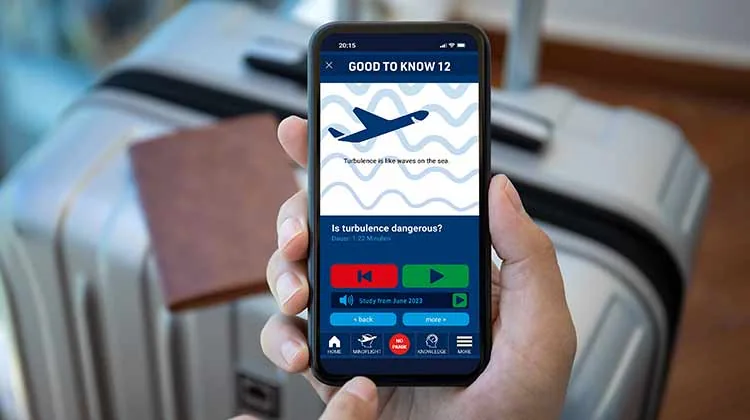
Is turbulence dangerous?
Turbulence is the most common trigger of anxiety on board — and at the same time one of the biggest misunderstandings. Commercial aircraft are built to withstand even severe turbulence far beyond anything that occurs in normal operation. The wings are deliberately flexible and bendable: they give under load rather than break — this is an intentional safety feature, not a sign of weakness.
- Turbulence is unpleasant and can be frightening, but it poses no structural danger to the aircraft.
- The real risk comes from unsecured people and objects that can be thrown around during sudden movements.
- The single most important precaution is therefore very simple: keep your seatbelt fastened whenever you are seated — even when the seatbelt sign is off.
Knowing how safe flying really is does not automatically strip the fear of its power — because fear of flying is not a question of missing information. But it is an important building block: realistic facts form the foundation on which relaxation and training techniques can take lasting effect.
6. Symptoms of fear of flying
Fear of flying is an interplay of emotional, physical and cognitive reactions triggered by an overblown perception of danger. Broadly, they can be divided into physical and psychological symptoms.
Physical symptoms
- Racing heart and sweating driven by elevated adrenaline
- Shortness of breath and dizziness, often caused by hyperventilation
- Gastrointestinal issues such as nausea or stomach aches
- Trembling and muscle tension
Psychological symptoms
- Intense nervousness and inner restlessness — days before the flight
- Panic attacks: sudden, overwhelming waves of intense fear
- Catastrophic thoughts such as “The plane is going to crash”
- Feelings of helplessness and loss of self-confidence
The symptoms often reinforce one another in an anxiety spiral. Understanding this dynamic is an important step toward breaking it.
7. Overcoming fear of flying
What should you do about fear of flying? In short, a combination of three building blocks helps, each reinforcing the others:
The three building blocks at a glance
- Preparation: realistic knowledge about aviation safety and turbulence takes the ground from under catastrophic thoughts.
- Acute relaxation: slow, deep breathing, progressive muscle relaxation and deliberate distraction calm the body in the decisive moment.
- Structured CBT training: for severe anxiety, targeted training based on cognitive behavioral therapy can sustainably reduce the fear at its root — for example through gradual exposure.
Overcoming fear of flying is a process that requires patience and conscious effort. With the right strategies, flying can once again become a safe and enriching experience.
PassengerGuard — your fear-of-flying coach


Frequently asked questions
The fear of flying seminar for your pocket.
PassengerGuard helps you overcome your fear of flying step by step — scientifically evaluated and available anytime.
Including scientifically based training plans, evaluated by Ruhr University Bochum.
Related Topics
Fear of flying in children
How to prepare your child for the flight calmly and gently.
Learn moreFear of flying test: where do you stand?
A friendly self-check to see how strong your fear of flying is.
Learn moreBreathing exercises for fear of flying
Simple breathing techniques that noticeably calm you on board.
Learn moreFear of flying app
PassengerGuard: mental flight training based on CBT and instant relief during panic — offline on board, evaluated by Ruhr University Bochum.
Learn more18 tips to overcome fear of flying
Proven strategies and practical tips to help you overcome your fear of flying step by step.
Learn morePanic attack first aid
Instant tips for self-help during panic attacks on a plane — breathing exercises and calming techniques.
Learn moreThe best fear of flying apps compared
A fair comparison of SkyGuru, SOAR, VALK & PassengerGuard — strengths, pricing and a table.
Learn moreFear of flying app that works offline
Does PassengerGuard work offline? Breathing guides, grounding exercises and calming audio run in airplane mode — no in-flight Wi-Fi needed.
Learn moreChairflying: a CBT exercise
Mentally rehearse a flight step by step from your chair — a CBT graded-exposure exercise that calms fear of flying before you board.
Learn moreThe PassengerGuard fear-of-flying study
How the FBZ at Ruhr University Bochum evaluated and accompanied the PassengerGuard training — ~150 participants, training flight at Düsseldorf Airport.
Learn moreFear of flying FAQ
The most common questions about fear of flying, panic on a plane and the app — answered concisely.
Learn moreFear of flying glossary
Key terms from aviophobia to turbulence — explained briefly and accurately.
Learn moreHow safe is flying, really?
The reassuring facts and statistics on why flying is one of the safest ways to travel in the world.
Learn moreUnderstanding turbulence calmly
Why turbulence is harmless for the aircraft – and how to stay calm and at ease through it.
Learn moreHow common is fear of flying?
You're not alone: how many people share this fear – and why that's reason for hope.
Learn moreYour first flight: step by step
A calm walkthrough from check-in to landing – made for nervous first-time flyers.
Learn moreThe best seat when you fear flying
Which seat feels calmest – and how to choose it on purpose.
Learn moreOvercome fear of flying without medication
Natural, effective strategies against fear of flying – entirely without pills.
Learn moreFear of flying on holiday
Start your trip relaxed when only the flight stands between you and your holiday.
Learn more